
Avalon Grover 04/28/2023
In her book Powers of Horror, Julia Kristeva defines abjection as what is “radically excluded and draws me towards the place where meaning collapses” (Kristeva, 2), or in other words, the human reaction to a threatened, or absolute, breakdown of the distinction between self and object. She goes on to explain that, while abjection seems heavily associated with the grotesque, it is also what protects us, or our superegos, by showing us our human reaction, wrenching us from these horrors, and physically driving us away from “a massive and sudden emergence of uncanniness, which familiar as it might have been in an opaque and forgotten life, now harries me as radically separate, loathsome. Not me. Not that. But not nothing, either. … On the edge of non-existence and hallucination, of a reality that, if I acknowledge it, annihilates me” (Kristeva, 2). Kristeva explains the importance of bodily fluids, and specifically the corpse, in relation to the knowledge of death versus the understanding of it; by physically seeing the decay, the expulsion of bodily excrement and fluids, and the lifelessness of a body prompts abjection, resulting in our own expulsion of bodily fluids, to establish a separation between our humanity and the corpse’s lack thereof. Moreover, the physical entity of the corpse is, to Kristeva, the perfect example of abjection in that it is the literal representation of the breakdown between subject and object and is vital to our understanding of the symbolic order, which is the social world of language, acceptance of the law, and intersubjective relations, allowing us to deal with others. Surrealism is defined as an Avant Garde movement seeking to express the desires and realities of the unconscious mind through literature, film, and art. In relation to Surrealism as a whole, abjection is a nonphysical thing, an object that is not an object that can be represented; it is a process that may only be represented through artifice. Therefore, artists operating in the Surrealist movement may only display abjection through artificial pieces to achieve the same process, the shock and disgust, that abjection is. The goal is to visualize this unconscious process of rejection and horror as well as understand the sexual perversions hidden within.
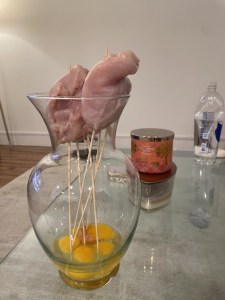
For my project, I decided to prompt abjection in my viewers using materials associated with death, but not directly associated with human death. Instead, I chose to combine my experience in floral arrangement and the surrealistic nature of abjection, as well as its direct relation to sexual perversion in death, to create a “flower bouquet” of sorts. I filled a flower vase, one I have used many times before, filled with skewered, raw chicken breasts, essentially to replace the flowers one would expect, and broken chicken eggs where water should be. I am manipulating a sacred object in a sacred space, my home living room, to threaten my roommates’, and my own, sense of cleanliness and the propriety of our home by bringing in, and thus referencing, the bodily functions in relation to death and sexual perversion. Furthermore, the use of broken chicken eggs in replacement of water also begs the age-old question: which came first, the chicken or the egg? In this case, it is the egg because the chicken breast grows from the yolk and membrane of an unborn chicken, providing nutrients and growth supplements for a full chicken to grow. In relation to the idea of “the improper/unclean” (Kristeva 2), the raw chicken breasts are notorious for their bacterial infection, salmonella, that may be spread through touch or general uncleanliness as well as the risk of contamination of my flower vase and my living room with the contents it holds: the chicken breasts and the chicken eggs. In Powers of Horror, Kristeva explains the concept of food loathing, which she describes as “the most elementary and most archaic form of abjection” (Kristeva 2) and goes on to say that the experience of nausea is what “others” one from another who desires the object that triggers that nausea. In this case, while I did not experience the food loathing effects of abjection, my roommates did and physically expelled their own bodily fluids in response, marking my surrealist piece as successful in that regard. It is “what disturbs identity, system, order” (Kristeva 4). My project does what Surrealists dealing with abjection do in that it visualizes the unconscious process of rejection and horror, as previously stated, and attempts to inflict that process onto its viewers.
The use of raw chicken breasts, instead of another part of the animal, also comments on the sexual desires of the unconscious mind and the destruction of those anatomical parts. It also threatens the stability of the ego and triggers the jouissance while also maintaining abjection. In terms of jouissance, Kristeva defines it as “where the object of desire…bursts with the shattered mirror where the ego gives up its image in order to confront itself in the Other” and also explains “one does not know it, one does not desire it, one joys in it [on enjouit]. Violently and painfully… It is simply a frontier, a repulsive gift that the Other, having become alter ego, drops so that ‘I’ does not disappear in it but finds, in that sublime alienation, a forfeited existence. Hence a jouissance in which the subject is swallowed up but in which the Other, in return keeps the subject from foundering by making it repugnant” (Kristeva 9). Essentially, she describes the mentality behind the fascination with horror beyond the repulsion from it as well as why there is a form of pleasure and perversion tied to abjection. It is why some are drawn to horror films or interested in the subjects of violence, disgust, and sexually perverse actions, objects, or ideas. We divide ourselves between that which is repulsed and that which is fascinated to preserve our identity and sense of self, to grip onto the mantles of reality by distinguishing the line between investing oneself in the perverse and running from it. Therefore, abjection must persevere, because it preserves us from losing all sense of being and preventing us from becoming fully the alter ego. The Other protects us by making us repugnant and averse to what we see, feel, and desire. Through the creation of this chicken breast bouquet, I found myself victim to Kristeva’s theory in that I was both enthralled and disturbed, disgusted yet invested, and wanted to continue to its completion and continue to look at it but still maintain the loathing I feel for it. Using the breast of the chicken as opposed to the leg or wing directly approaches the revulsion of anatomical division and, as my position as a woman therefore having breasts, outrages the subjectivity and security of the breast as attached to its counterpart, the body. While the use of any raw, skinned corpse would be enough for most to trigger abjection, the fact that they are breasts alludes to the idea that these chicken breasts could potentially be my own skinned and skewered to be displayed in someone’s living room. It prompts a much more uncomfortable and sinister feeling that nausea. This reaction is the process of abjection where one must separate themselves from the subject or the object in order to avoid mental chaos. In her book, Kristeva speaks of the ego and the superego which function to divide that which is aware and that which is not. For men, the interpretation might differ. Knowing that the corpse skewered in the vase is a breast may give way to unconscious sexual desires of the breast and its association with the mother. Freud’s Oedipus complex, in simple terms, is a boy’s unconscious desire to have intercourse with his mother and the simultaneous fear of his father as one who would punish and rival him for this act or the desire. The boy craves the mother’s breasts as both a food source, mainly infants, and a sexual perversion that the mother’s breasts are his to enjoy. Seeing breasts, whether they be chicken or not, triggers abjection for a man through the Oedipus complex in a similar way that abjection is triggered for women: these breasts may the breasts of one’s mother and thus the distinction between subject and other is disintegrated and must be reestablished for the man to continue.
Beyond the idea of the breast, the use of a broken egg is integral to many forms of surrealism and specifically the sexual perversions it seeks to expose. Throughout surrealist art, the egg has been associated with the eye because of its similar anatomical disposition and its position as the potential for a life, fertility. In Georges Bataille’s The Story of the Eye, one character, Simone, argues her obsession with the eye stems from her association of it with “a calf’s eye, because of the color of the head (the calf’s head) and also because the white of the egg was the white of the eye, and the yolk the eyeball. The eye, she said, was egg-shaped” (Bataille 38). Essentially, this connection derives from the relation of the egg with fertility and the eye with voyeurism; Simone chooses a calf to explain her interest, which is the infant version of a cow which may also relate to the same concept in an egg, that the egg will one day become a chicken just as the calf will one day become a cow. The egg, as the fertile conception of sex in any organism, is henceforth place as the nutrient source for the skewers of chicken breast in this vase, destroying their ability to achieve full growth but maintains their symbolism as a voyeuristic object. On the topic of voyeurism, the eggs placed in a clear vase encourages the subject in that there is no true barrier between the egg, or the eye, and the viewer. This disintegration of barriers is abjection; the viewer does not recognize the familiarity in the egg nor the chicken breasts yet still feels the Other in the egg’s placement looking up as well as the chicken corpses sticking out. Furthermore, the viewer is place in the position of the voyeur as well, not just the victim of it. Just as abjection pushes the audience to react, it also forces them to watch. It is near impossible to simply glance at the chicken bouquet and is essentially required that the viewer take time to fully understand it before coming to the conclusion of abjection. As previously stated, the different experiences that the different sexes may experience also exposes the viewer’s unconscious voyeuristic desire through the mother’s breasts and the egg’s fertility. Thus, this chicken bouquet contains a voyeuristic ability but also encourages the viewer to engage in their own.
Julia Kristeva’s account on abjection in her book, Powers of Horror, breaks down the concept and reveals that it is the human reaction to the breakdown, or threatened breakdown, of subject and object or self and other resulting in the expulsion of bodily fluids. She explains the concept of food loathing and its relation to abjection as well as the sexual aspects and unconscious aspects of the notion. In my final project, I have created a piece meant to embody her theory and add commentary on It. It is a clear vase, filled with broken eggs, and displaying skewers of raw chicken breasts instead of flowers. I combined by love of flower arranging with the art of surrealism and placed It in my home living room where my roommates may interact with it freely, to which they will promptly ask me to take it away. The point was to trigger abjection in both me, as the creator, and my roommates using the bodily fluids and corpses of chickens, as substitute for humans which Kristeva mainly spoke of, and to display it in a sacred space to both disrupt the normality of the room and embody my favorite aspect of Surrealism: shock. Through the process, I explored new ways that the piece may be interpreted and how abjection may be triggered; from the sexual perversions of Freud’s Oedipus complex to the fear of oneself being skewered, to food loathing. I hope you enjoy your experience with it through the photographs provided below.
Works Cited
- Bataille, George, et al. Story of the Eye. Penguin Books, 1983.
- Kristeva, Julia. Powers of Horror: An Essay on Abjection. Nota, 2017.
 Where Art Never Dies
Leave a comment