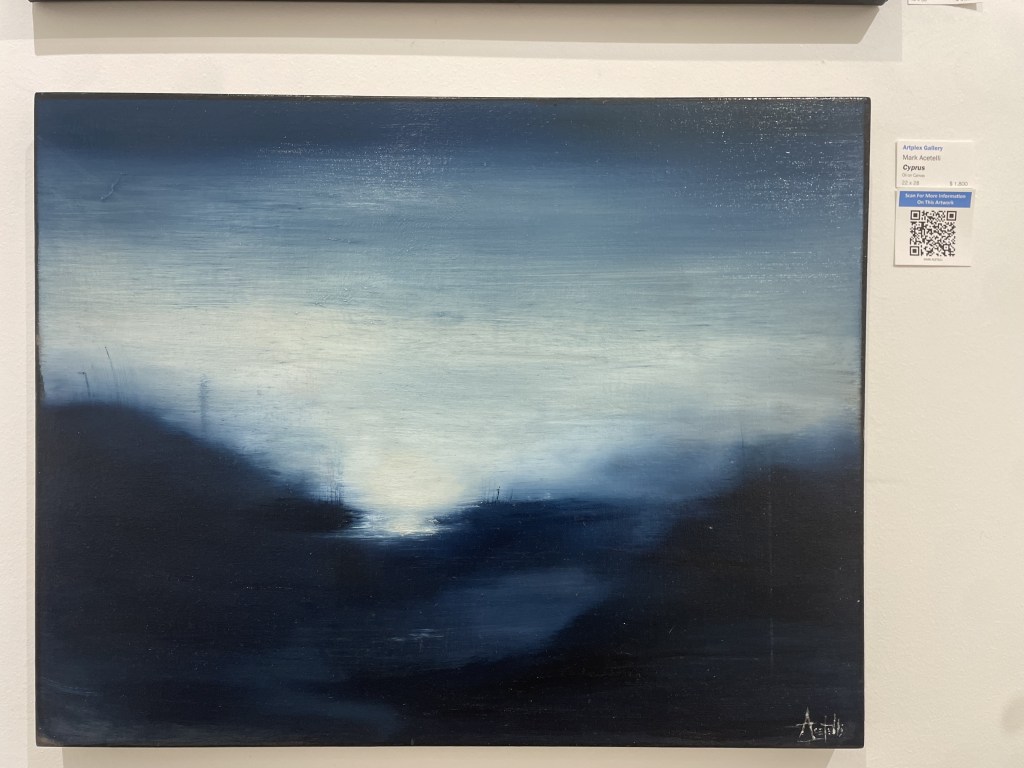

My first endeavor to galleries in Los Angeles brought me to ArtSpace and Artplex, two sister contemporary art galleries which strive to display, debut, and market various artists of both local and national importance. They offered an incredible range of art, from sculpture to neon signs to paint to digital media and I became fascinated by it all. In my visit to the latter gallery, I discovered the works of Mark Acetelli, an abstract and impressionist artist who, using oil on canvas, crafts beautiful and emotional pieces filled with both muted and vivid colors and a captivating focus on the liminal spaces. Though the gallery obtained many works of his, two in particular caught my eye. Placed vertically with one on top of the other, Cyprus and Emerald Dance portray the agonization and the struggle of liminality, as well as its beauty.
To understand his works, one must first understand the artist. Born in Detroit, Mark Acetelli’s family immersed him in the arts early on, as his mother was a painter herself. He was encouraged to explore all forms of self-expression before he eventually settled on paint where he forges works he describes as “simple expressions of complex thoughts, created by capturing the physical mixed with the spiritual” (Acetelli). Acetelli, who is self-taught, uses various tools to create his oil paintings and prefers to focus on the journey rather than the outcome, leaving his art free to become what he needs to express instead of what he chooses. In doing so, he achieves a greater clarity of emotion, thus conveying an opportunity for his viewers to do the same.
Using the theory of color, Acetelli creates a painting describing the full range of the color blue across space in his work titled Cyprus. His image of the edge of land and the beginning of the ocean allows both him and his viewers to interpret the piece on a personal level. He frames the center with the darkest hues of blue, establishing an area that catches attention with its bright white colors and expressive, loose brushstrokes. This area is called the coup d’oeil. This is a French word meaning “stroke of the eye” but in terms of art, refers to the aspect or area of a painting that is most striking using high contrast and bright colors. Usually, it is the part one’s eye is most drawn to. In this case, Acetelli places his coup d’eoil just below the center of the painting as both an end and beginning point for the lightest colors. The delicate detail provided creates an estuary, lit up by the light of an omnipresent moon. While most brushstrokes throughout the canvas are loose and blended, the artist uses a small paintbrush and short brushstrokes to mimic the movements of water. He places light blue and white over dark blue and black before allowing the light to overtake the upper half of the canvas, thus creating the ocean. By adding both dark and light hues, he adds depth in the middle to an otherwise 2d painting. On the right of the coup d’oeil, Acetelli places a miniscule stick man, who stands facing away from it with his hands placed behind his lower back in support, a stance typically taken for relaxation. His small existence in a vast painting forces the viewer to not only take a double-take, but physically walk closer to confirm their eyes.

The second painting, Emerald Dance, questions the very core of dance which is freedom, grace, and control. Instead, we see a dancer trapped mid-twirl with streaks of mistakes found haphazardly toward the bottom of the painting as if it gets progressively more chaotic the more you look at it. Mark Acetelli paints various hues of green ranging from dark to light with streaks of red, white, and tan to create the silhouette of a woman, evident through the billowing skirt and a small waist. She is positioned as slightly turned to her left, allowing a small view of her breasts to become visible in the silhouette. The green paint mainly surrounds the woman, starting with a darker shade at the top before becoming progressively more vivid towards the bottom and concluding with a thin strip of the darkest hue of green. Instead of green, she is filled with tan, white, and red colors, painted horizontally. The thick brushstrokes are most clear in the confluence between the background green and the silhouette’s colors. A stark horizonal strip of white and green tears from one end of the canvas to the other with drips of paint falling all the way down, drawing the viewer’s attention there. Another intersecting strip begins in the skirt and again falls to the bottom of the canvas, however this area does not contain the same brushstrokes as the previous; instead, the paint appears almost as a deliberate mistake, as if the paintbrush was forcibly pressed into one part of the painting with an enormous amount of paint and allowed to drip vertically to the bottom of the canvas.
The description Artplex provides for the artists’ paintings is this: “Mark Acetelli’s oil and mixed media paintings awaken the viewer’s sense of exploration and adventure; they demand a new discovery.” I disagree. Instead, I argue Mark Acetelli’s paintings, especially the two described today, Cyprus and Emerald Dance, portray confusion rather than adventure, pause rather than continuance, and potential rather than kinetic energy. In the former, the artist focuses the attention of an estuary, the connection between ocean and river. The liminal space of an estuary provides Acetelli with a challenge. He conveys an intense beauty and a feeling of serenity in a moment of implicit chaos. The mix of fresh and salt water may be dangerous and beautiful at the same time, deadly to species of either side; a line is blurred. There is beauty in that. Two concepts that should not blend, do and thus death occurs. Mother nature demands the price of life to provide balance, therefore as a result of those that could not withstand the impact of salt and fresh water, a river is born. The man at the edge stands as a guide through the confusion of liminality and a representation of one who has made it from one side to the other. In the Emerald Dance, Acetelli proves that the transitional space between borders impacts more than our emotional capacities. He shows the physical implications of it. The painting imagines a dancer mid-twirl and seemingly looking at viewer, tho the details are so disfigured and abstracted it is impossible to be sure. Mark Acetelli’s use of vibrant, horizontal brushstrokes creates the feeling of movement and dizziness, thus placing us mid-twirl along with his subject. In doing so, he forcibly pushes us into a liminal space filled with chaos and uncertainty. By choosing a dancer as his subject, the artist questions the nature of dancing as one of control and strength. Instead, this emerald dancer displays fear more than absolute and unpredictability rather than control.
In his paintings Cyprus and Emerald Dance, Mark Acetelli captures the essence of liminality by choosing ambiguous spaces suggestive of a transition, a dancer mid-twirl and an estuary with a man on one side. This liminality is further reflected in the artist’s expertise in color blending. By combining a sense of combination in his brushwork with a subject of chaos and confusion, Acetelli allows the viewer to interpret a world of emotion, whether that be a feeling of adventure and opportunity as the Artplex description suggests or one of understanding and acceptance of the world as a place of change and uncertainty.
Works Cited
- Acetelli, Mark. “Mark Acetelli Biography.” Mark Acetelli, http://www.markacetelli.com/artists/30-mark-acetelli/. Accessed 14 June 2023.
- Art@artplexgallery.com. “Cyprus (Mark Acetelli) – Artplex Gallery Los Angeles: Buy or Rent Original Art.” Artplex Gallery, http://www.artplexgallery.com/en/artwork-cyprus. Accessed 15 June 2023.
 Where Art Never Dies
Leave a comment